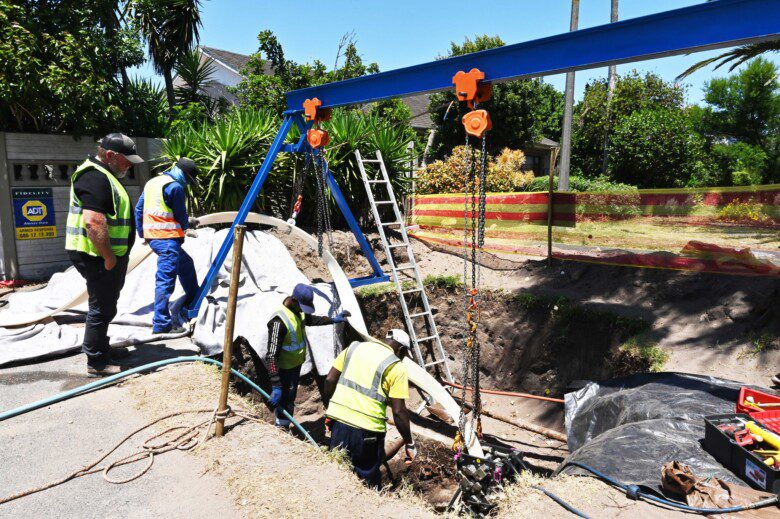
The City of Cape Town’s Water and Sanitation Directorate is rehabilitating 28 km of bulk sewer pipelines across the Cape Flats, South Africa’s largest sewer upgrade project, which will benefit 300,000 households primarily in lower-income neighbourhoods. By upgrading this infrastructure, the project significantly extends the life of a critical bulk sewer network, which will reduce the risk of collapse, leaks or overflows.
This extensive, multi-phase sewer rehabilitation is one of the City’s flagship projects, which will extend this infrastructure’s lifespan by an estimated 100 years to benefit residents in Athlone, Hanover Park, Lotus River, Ottery, Grassy Park, Eagle Park, Pelican Park and surrounding areas.
The total project value is R1.35 billion, invested over multiple years, and is expected to be completed by 2030.
On Thursday, 13 November 2025, Councillor Zahid Badroodien, the City’s Mayoral Committee Member for Water and Sanitation, joined the project team on site to oversee progress.
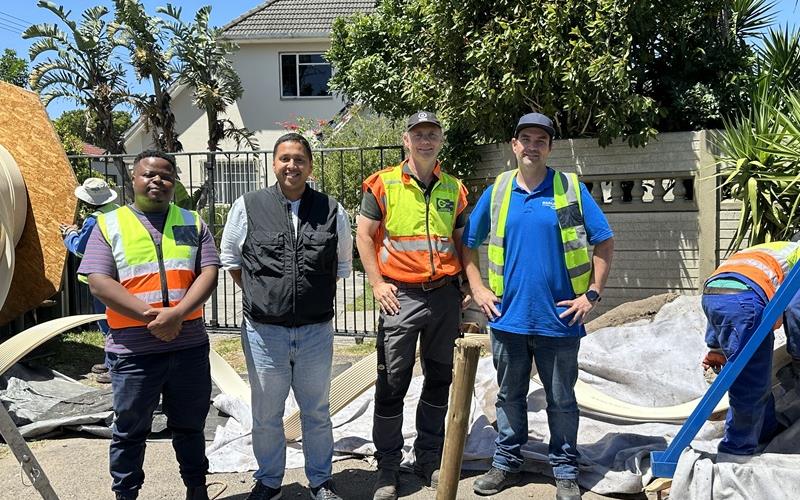
City Project Manager, Comfort Mathenjwa; the City’s Mayoral Committee Member for Water and Sanitation, Councillor Zahid Badroodien; and City-appointed contractors Craig Bowker and Jared Smit.
‘This major rehabilitation project will enable the City’s sewer infrastructure to channel higher volumes of flow across the Cape Flats. The extended lifespan also future-proofs us, as the additional capacity is designed to better meet the demands of an ever-growing city.
‘This investment will restore the structural integrity of the pipes, as well as prevent leaks and groundwater ingress, so that the system can continue to reliably convey sewage from properties to pump stations and finally wastewater treatment works,’ said the City’s Mayoral Committee Member for Water and Sanitation, Councillor Zahid Badroodien.
| Location | Pipe Length (m) | Number of Manholes |
| Rylands | 888 | 11 |
| Gatesville | 880 | 11 |
| Mountview and Penlyn Estate | 1764 | 26 |
| Pinati Estate | 866 | 13 |
| Wetton | 866 | 13 |
| Total | 5264 | 74 |
Innovative method
The underground bulk sewer is being rehabilitated using Spirally Wound Piping (SWP) – the same innovative method used in earlier phases. The PVC liner was manufactured internationally (including Germany) and is designed to extend the lifespan of the pipeline by up to 100 years.
The lining consists of a continuous PVC strip, wound into the existing pipe by a machine which is placed inside a manhole. It creates a new pipe lining inside the old one. Once complete, a robotic crawler inspects the line for verification and quality assurance.
The scope of work also includes:
-
Bulk cleaning of sewers from manholes
-
Point repair work (where applicable)
-
Manhole rehabilitation – demolishing existing brick manhole shafts and intermediate slabs, then replacing them with new, precast concrete rings and intermediate slabs
-
Rehabilitating existing brick manhole chambers by replacing missing bricks or casting a 150 mm-thick concrete wall on the inside of the manhole
-
Applying a 15mm Calcium Aluminate Cement (CAC) layer on manhole rings, intermediate slab surface, and 25mm CAC on brick manhole surfaces
‘Thank you to residents in the affected areas for their patience and understanding for the inconvenience of traffic disruptions and possible foul odours while this essential work takes place,’ said Councillor Badroodien.
This bulk sewer network serves an estimated 8,000-hectare area across the Cape Flats. It is a critical link to transfer flow between two bulk wastewater catchment areas. A significant portion of the inflow originates from the Raapenberg and Bridgetown pump stations, extending approximately 14km to the Cape Flats Wastewater Treatment Works.