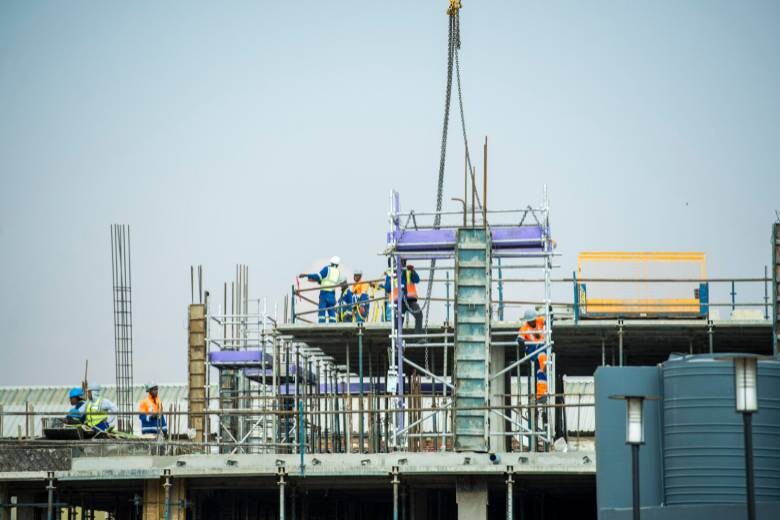
A major compliance operation at a Cape Town CBD construction site has resulted in the discovery of 79 undocumented foreign nationals, as authorities intensify efforts to tackle labour law violations, immigration breaches and regulatory non-compliance in the building industry.
The operation, conducted on 20 May 2026 at a construction site on Lower Long Street, involved multiple government departments and enforcement agencies, including the Building Industry Bargaining Council (Cape of Good Hope) (BIBC), the Department of Employment and Labour (DoEL), the Department of Home Affairs (DHA), Immigration Services, SAPS, Metro Police and the Traffic Department.
79 Undocumented Workers Identified
According to the BIBC, the main contractor on the site was Tri-Star Construction (Pty) Ltd.
Site inspection records indicated that approximately 200 employees were working on the project at the time of the operation. About half were identified as foreign nationals and were removed from the site for verification by the Department of Home Affairs.
The DHA later confirmed that 79 of the workers were undocumented foreign nationals.
The inspection was coordinated by Mr Luthando Nkuzo, Principal Inspector at the Department of Employment and Labour, as part of a broader multi-disciplinary compliance and enforcement initiative focusing on labour legislation, occupational health and safety, immigration requirements and employment practices.
Work Temporarily Suspended During Inspection
Construction activities were temporarily halted while officials carried out inspections and document verification processes.
The operation resulted in multiple arrests linked to undocumented foreign nationals identified during the inspection.
Deputy Minister of Employment and Labour, Jomo Sibiya, addressed workers during the operation and explained that the inspection formed part of wider efforts to strengthen labour law compliance across South Africa.
Authorities Target Labour and Compliance Risks
According to the BIBC, the operation reflects a growing trend towards coordinated enforcement within the Western Cape construction sector.
“These inspections are about far more than undocumented workers,” said Danie Hattingh, spokesperson for business at the BIBC.
“They are about strengthening accountability in an industry increasingly challenged by subcontracting abuses and regulatory non-compliance.”
Subcontracting Under Increased Scrutiny
Hattingh said large construction projects often involve multiple contractors, subcontractors and labour brokers, creating opportunities for employers to avoid labour obligations and registration requirements.
“Large projects often involve multiple layers of contractors, creating opportunities to bypass labour obligations and registration requirements,” he said.
“Integrated operations enable regulators and enforcement agencies to respond far more effectively.”
As the recognised bargaining council for the Greater Cape Peninsula building sector, the BIBC’s role included verifying contractor and subcontractor registration and ensuring compliance with collective agreements covering wages, working conditions, benefit contributions and employer registration obligations.
Non-Compliance Impacts Workers and Businesses
According to Hattingh, non-compliance affects both workers and law-abiding employers.
“Non-compliance not only affects workers,” he said.
“It also undermines compliant employers who are forced to compete against companies cutting costs by operating outside the law.”
Authorities have increasingly identified the construction industry as a high-risk sector for labour exploitation, undocumented employment and regulatory avoidance, particularly on large developments that rely heavily on subcontracted labour.
Similar Operations Conducted in Table View
The Lower Long Street inspection follows two similar multi-agency enforcement operations carried out in Table View during November 2025.
Those operations, coordinated by Mr Vincent Domingo, Principal Inspector at the Department of Employment and Labour, targeted employment law violations and undocumented labour at sites where the main contractors were Tailor Made Construction (Pty) Ltd. and Balwin Properties (Pty) Ltd.
According to the BIBC:
28 undocumented foreign nationals were identified at the Thorpe Garage development.
A second operation at the Suikerbos Lifestyle Estate development encountered such a large number of foreign nationals that the inspection could not be completed on the same day.
More Compliance Operations Expected in 2026
Hattingh said the message to contractors and developers is becoming increasingly clear.
“Compliance with labour legislation, bargaining council agreements, immigration requirements and occupational health and safety standards is no longer optional.”
The BIBC expects joint enforcement operations to increase throughout 2026 as collaboration between regulators and law enforcement agencies continues to strengthen.
Stronger Enforcement Environment Emerging
Industry stakeholders have increasingly highlighted the impact of non-compliance on wage levels, worker protections, fair competition and the long-term sustainability of the construction sector.
As a result, employment documentation, worker registration and compliance verification are becoming critical areas of focus for developers and contractors.
“We are seeing a much stronger enforcement environment emerging,” said Hattingh.
“Contractors that fail to comply with labour and regulatory obligations should expect increasing levels of monitoring and enforcement action.”
He added that the ultimate goal is to strengthen the industry.
“These operations are about protecting the integrity and sustainability of the building sector. A stronger culture of compliance benefits workers, responsible employers and the entire industry.”