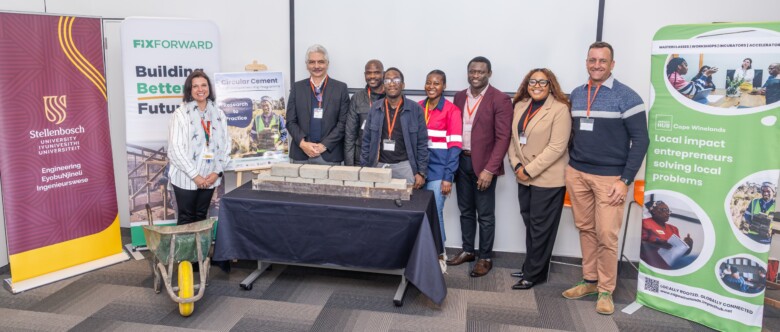
As rising cement prices continue to squeeze small construction businesses, a new circular cement entrepreneurship programme is giving young builders and brickmakers the opportunity to reduce production costs, strengthen their businesses and adopt more sustainable building methods.
The nine-month Circular Cement Youth Entrepreneurship Programme aims to support 100 entrepreneurs to build stronger, more profitable businesses while helping South Africa transition towards a more circular construction economy.
Designed for B-BBEE candidates under the age of 35 who already operate building or brickmaking businesses, the programme combines practical technical training, business optimisation support and access to innovative construction methods developed through Stellenbosch University research.
Developed by Fix Forward and Impact Hub Cape Winelands in collaboration with Stellenbosch University, the programme is funded by the Presidential Youth Employment Intervention (PYEI), administered through the Industrial Development Corporation (IDC), and supported by the Department of Employment and Labour. It responds to several pressing challenges facing South Africa’s construction sector, including rising material costs, youth unemployment and the need for more sustainable building practices.
Putting waste to use while cutting costs
Participants will learn how to use suitable waste-derived materials as partial alternatives to conventional cement. Based on Stellenbosch University research, these methods can reduce production costs while creating more sustainable building products.
Alongside the technical training, participants will receive business optimisation support tailored to their existing operations, one-on-one business coaching, access to tools, equipment and production support, and opportunities to build valuable industry networks.
Josh Cox, CEO of Fix Forward, says the programme was designed to help small construction businesses become more competitive while translating cutting-edge research into practical opportunities.
“We’re taking innovative research out of the laboratory and putting it into the hands of builders and brickmakers who can use it to strengthen their businesses,” he says. “When entrepreneurs have access to the right knowledge, practical support and market opportunities, they’re better equipped to grow sustainable businesses that create value within their communities.”
Real-world impact
Programme participant and brickmaker Vuyisile Handa is enthusiastic about the value of the programme.
“It has ignited so many dreams for entrepreneurs like me,” he says. “Now we can save on cement and aggregates, make bricks that are climate-friendly and sell more affordable products to people in our communities.”
Handa believes lower production costs will allow him to grow his business, create employment opportunities and make quality building materials more accessible to local customers.
Benefits of collaboration
Marli Goussard, CEO of Impact Hub Cape Winelands, said the programme demonstrated how collaboration between academia, industry, government and civil society could create practical economic opportunities.
“At Impact Hub Cape Winelands, we believe local people are best positioned to solve local challenges,” she says. “This programme equips builders and brickmakers with practical tools to improve profitability while adopting more sustainable practices. What makes it particularly powerful is the collaboration between academia, industry, government and civil society to ensure research is translated into real opportunities that can improve lives. By turning research into practical business opportunities, we’re helping entrepreneurs convert locally available waste materials into valuable construction products while building stronger businesses and creating lasting value for their communities.”
The programme is open to South African builders and brickmakers who:
- are under the age of 35;
- operate active businesses with real projects and customers;
- use cement regularly in construction or production; and
- are based in the Western Cape, KwaZulu-Natal, Mpumalanga or North West.
More information about the programme and the application process is available at: www.fixforwardacademy.co.za/ccp